early in the story
The Captain Arrives
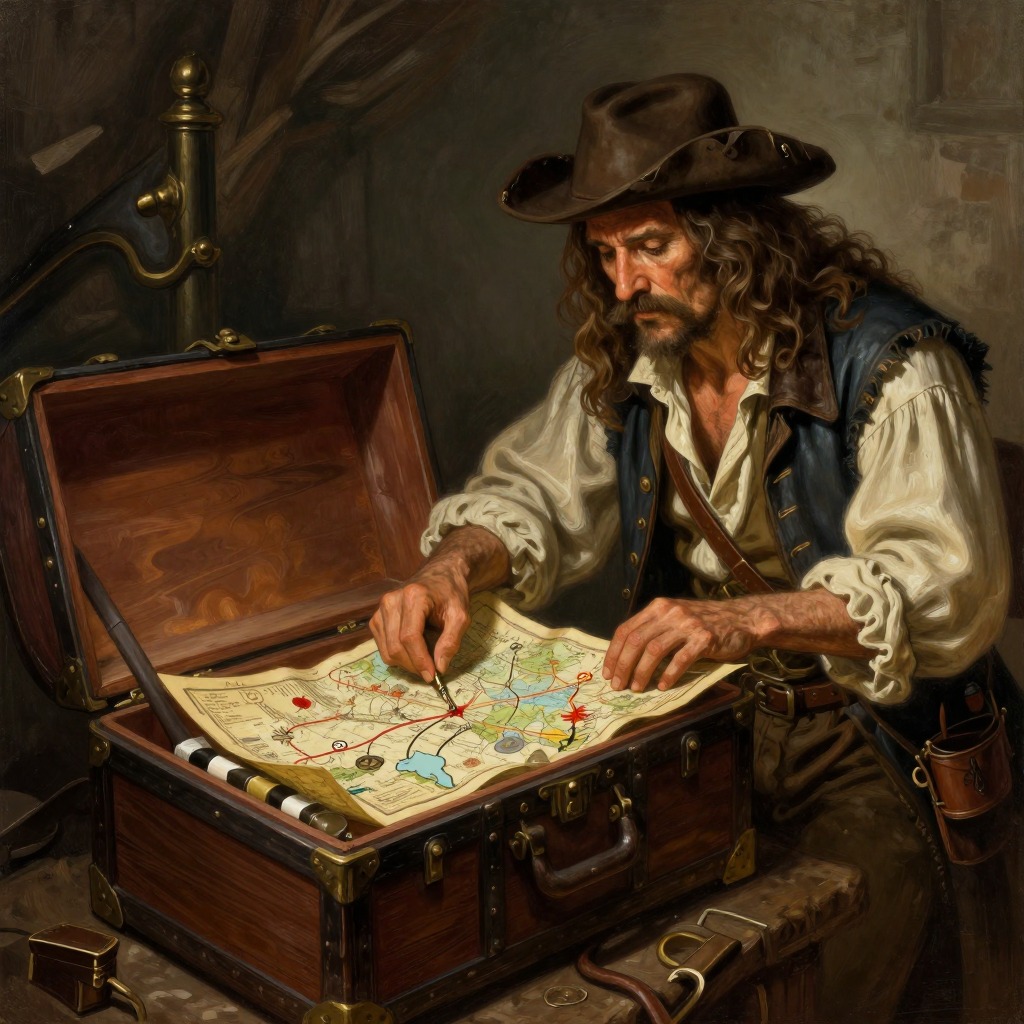
A tall, nut-brown old seaman with a sabre cut on his cheek arrives at the Admiral Benbow Inn, carrying a sea-chest. He introduces himself as 'captain' and takes lodging, paying in gold. He is taciturn and spends his days watching the coast with a brass telescope, and his evenings drinking rum and singing sea songs. He asks Jim Hawkins to keep a lookout for a seafaring man with one leg, promising a silver fourpenny each month. His presence frightens the locals, but also attracts some who admire his rough ways.
during the captain's stay at the inn
The Captain's Song and Dr. Livesey's Confrontation
One evening, the captain, drunk, begins singing 'Fifteen Men on the Dead Man's Chest' and demands silence. Dr. Livesey, visiting Jim's sick father, ignores him and continues his conversation. The captain threatens him with a knife, but Dr. Livesey, a magistrate, calmly warns him that he will hang at the next assizes if he does not behave. The captain backs down, and Dr. Livesey leaves, having established his authority over the old pirate.
a few weeks after the doctor's confrontation
Black Dog Appears
On a frosty January morning, while the captain is out walking, a pale, tallowy man with two missing fingers enters the inn. He asks for 'Bill' and reveals himself as Black Dog, an old shipmate of the captain. When the captain returns, he is shocked and frightened to see Black Dog. They sit down to talk, but soon an argument erupts, and they draw cutlasses. Black Dog flees, wounded in the shoulder, and the captain suffers a stroke from the exertion and excitement.
immediately after the fight with Black Dog
The Captain's Stroke and Confession
After Black Dog's escape, the captain collapses. Dr. Livesey arrives and bleeds him, saving his life. The doctor warns him that rum will kill him. Later, the captain confides in Jim, telling him that he was first mate on Captain Flint's ship and that he possesses a map of the treasure. He fears that his old shipmates, including a one-legged man, are after it. He instructs Jim to go to Dr. Livesey if they give him the black spot, and promises to share the treasure with him.
the day after the captain's stroke
The Black Spot Delivered
A blind beggar, Blind Pew, comes to the inn and forces Jim to lead him to the captain. He delivers a black spot, a summons, to the captain, who reads it and collapses. The captain dies of a stroke, and Pew escapes. Jim and his mother are left with the body and the fear of the pirates returning.
immediately after receiving the black spot
The Captain's Death
The captain, upon receiving the black spot, reads it and cries out that he has until ten o'clock. He tries to rise but falls dead from apoplexy. Jim and his mother are horrified, and Jim bursts into tears, the second death he has witnessed. The blind man has vanished, and the threat of the pirates looms.
the night of the captain's death
Opening the Sea-chest
Jim and his mother, determined to collect the money owed to them, return to the inn and open the captain's sea-chest. They find clothes, trinkets, and a canvas bag of gold. As they count out their due, they hear the blind man's stick tapping outside. They flee with the money and an oilskin packet containing papers, just as the pirates break into the inn.
the same night, shortly after the Hawkins flee
The Pirates' Raid and Blind Pew's Death
The pirates, led by Blind Pew, ransack the inn, searching for the map. They find the money but not the packet. As they argue, they hear the sound of horses approaching. The revenue officers, alerted by a boy from the hamlet, arrive. The pirates scatter, but Blind Pew, in his blindness, runs under the hooves of a horse and is trampled to death. The officers take Jim to Dr. Livesey's house.
the same night, at Dr. Livesey's house
The Captain's Papers Opened
At Dr. Livesey's house, Jim gives the oilskin packet to the doctor and Squire Trelawney. They open it and find a logbook of Flint's crew and a map of an island, with three red crosses and the words 'Bulk of treasure here.' The squire is ecstatic and immediately plans an expedition to find the treasure. Dr. Livesey warns him to keep the matter secret, but the squire is already talking of fitting out a ship.
weeks after the discovery of the map
Preparations in Bristol
Squire Trelawney goes to Bristol to fit out a ship. He buys the schooner Hispaniola and hires a crew, including a one-legged cook named Long John Silver. Silver helps him recruit a rough crew of sailors. Dr. Livesey is delayed in London, and Jim stays at the hall with old Tom Redruth. The squire writes a letter to Dr. Livesey, detailing the preparations and his excitement.
the day before sailing
Jim Meets Long John Silver
Jim, sent by the squire to deliver a note to Long John Silver at the Spy-glass Tavern, meets the one-legged cook. Silver is charming and friendly, and Jim is immediately reassured that he is not the feared one-legged sailor. However, Jim spots Black Dog in the tavern, and Silver pretends to be angry, sending men after him, but Black Dog escapes. Silver later reports the incident to the squire and doctor, who are satisfied with his conduct.
the day before sailing, aboard the Hispaniola
Captain Smollett's Complaints
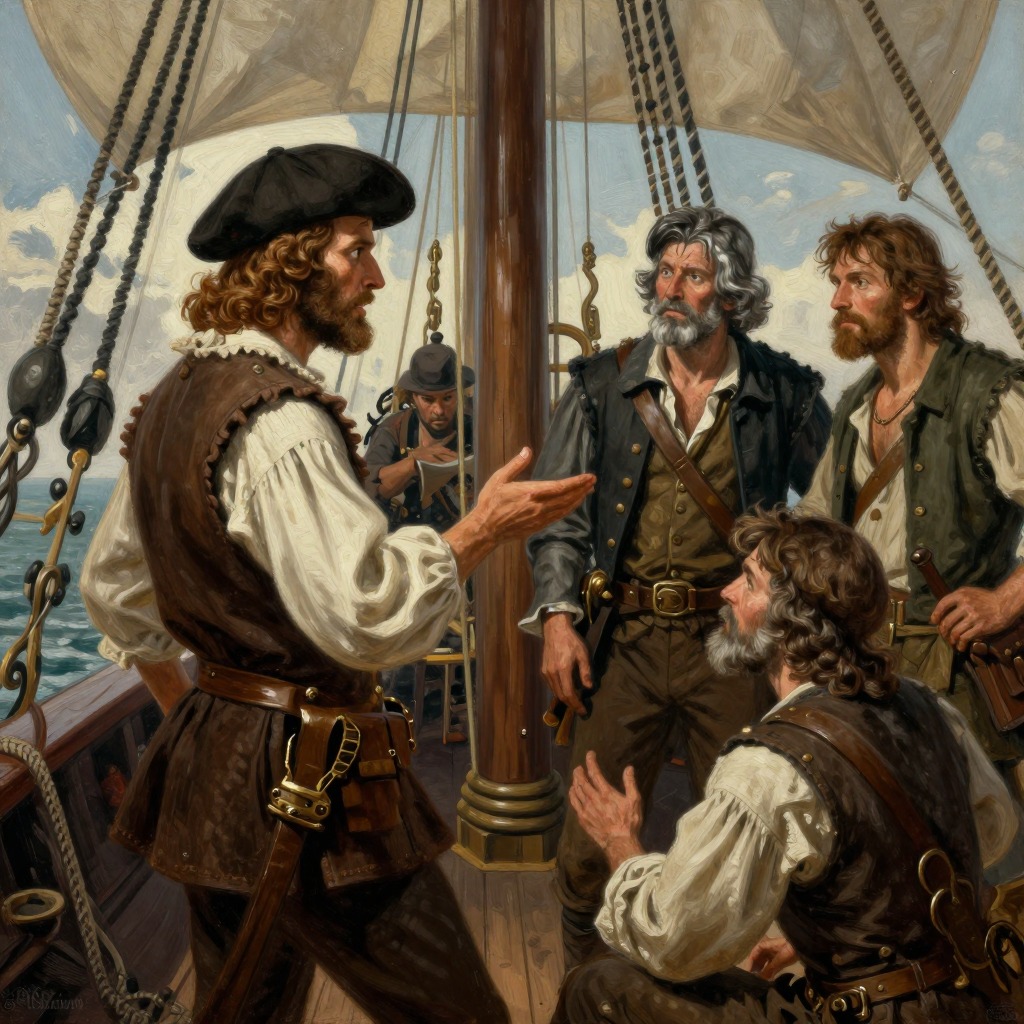
Captain Smollett, the newly appointed captain of the Hispaniola, expresses his displeasure to Squire Trelawney and Dr. Livesey. He dislikes the cruise, the crew, and the mate, Mr. Arrow. He complains that the crew knows too much about the treasure and that the powder and arms are stored in the fore hold. He requests that the arms be moved to the cabin and that the squire's own men be berthed nearby. The squire is offended, but the doctor agrees to the captain's precautions.
the morning of departure
The Voyage Begins
The Hispaniola sets sail from Bristol. The crew sings 'Fifteen Men on the Dead Man's Chest' as they weigh anchor. Jim is excited and tired. During the voyage, Mr. Arrow proves to be a drunkard and disappears overboard one night. The crew is advanced, and Job Anderson becomes the de facto mate. Long John Silver is kind to Jim, and the parrot Captain Flint screeches 'Pieces of eight.'
the last day of the outward voyage
Jim Hides in the Apple Barrel
As the ship nears Treasure Island, Jim climbs into an empty apple barrel to get an apple. He overhears Long John Silver talking to the crew, revealing that he is a pirate and that many of the crew are mutineers. Silver plans to wait until the treasure is found, then kill the honest men and sail away. Jim is terrified and realizes that the lives of his friends depend on him.
the same evening, just after Jim overhears the plot
Land Ho!
The lookout cries 'Land ho!' and the crew rushes to see the island. Jim slips out of the barrel and joins the others. Captain Smollett questions the crew about the island, and Silver claims to know it. The captain shows a copy of the chart, and Silver recognizes the landmarks. The ship is laid to, and the captain, squire, and doctor go below to discuss the situation.
the same night, in the cabin
Council of War
Jim tells the captain, squire, and doctor everything he overheard in the apple barrel. They are shocked and realize that the crew is mutinous. They count their loyal men: the captain, squire, doctor, Jim, and the three servants—only seven against nineteen. They decide to proceed cautiously and wait for an opportunity to strike. The captain proposes to allow the men ashore to see who will go, hoping to identify the loyal ones.
the next afternoon
The Shore Party
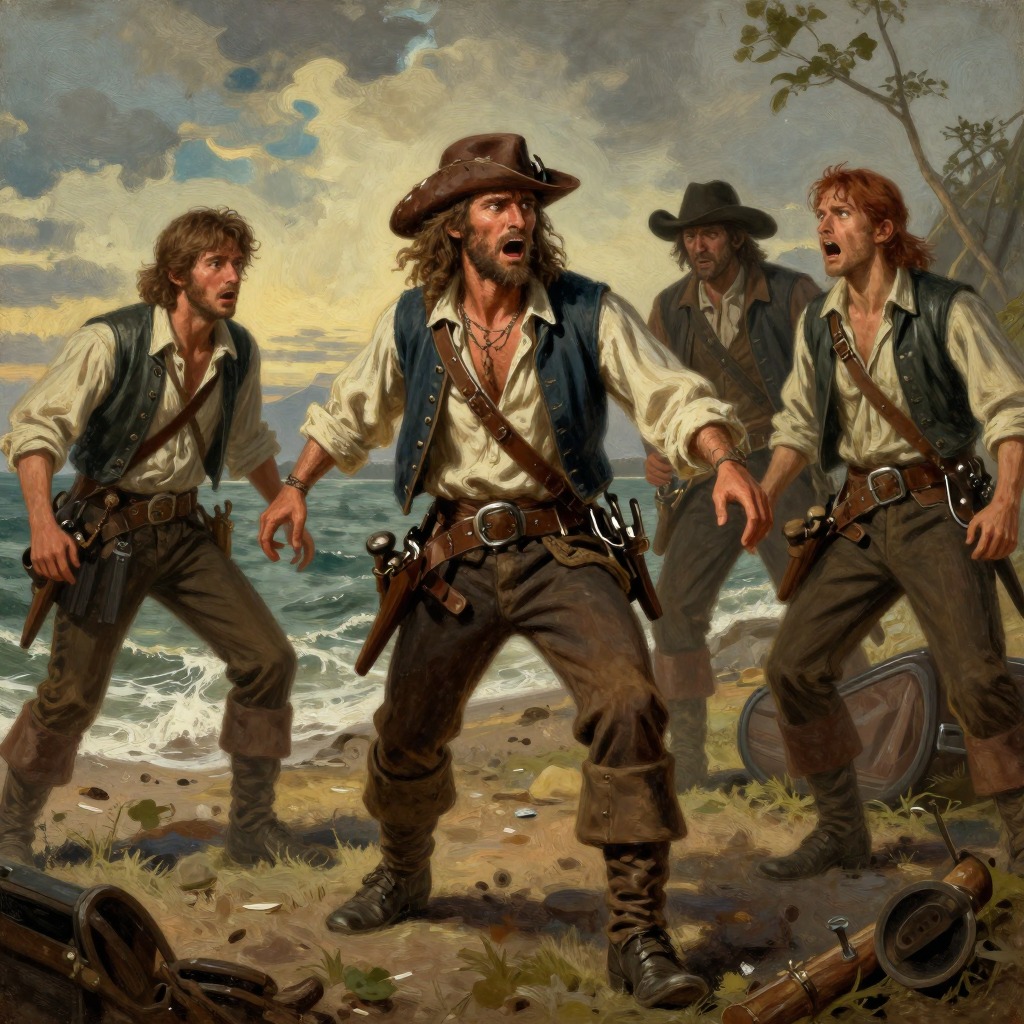
The captain allows the crew to go ashore for the afternoon. Thirteen men, including Silver, go ashore in two boats. Jim, on a sudden impulse, slips into one of the boats and goes ashore with them. He hides in the bushes and watches as Silver and another man, Tom, argue. Silver tries to persuade Tom to join the mutiny, but Tom refuses. Suddenly, a scream is heard from the marsh—another honest sailor, Alan, has been killed.
the same afternoon, in the woods
The First Blow
Silver, enraged by Tom's defiance, kills him with his crutch and knife. Jim, hidden nearby, witnesses the murder and flees in terror. He runs through the woods, fearing for his life. He hears the sound of a cannon and later sees the Union Jack flying over the stockade, indicating that his friends have taken refuge there.
the same afternoon, after fleeing from Silver
Jim Meets Ben Gunn
Jim encounters a strange, ragged man in the woods—Ben Gunn, who has been marooned on the island for three years. Ben tells Jim that he was on Flint's ship and knows about the treasure. He asks if Jim can get him some cheese and promises to help Jim's party. Jim tells Ben about the situation, and Ben reveals that he has a boat hidden. They hear the cannon and run towards the stockade.
the afternoon of the first day ashore
The Stockade Secured
The doctor, squire, captain, and their loyal men—Hunter, Joyce, and Redruth—abandon the ship and take refuge in the stockade, a log-house with a palisade. They bring provisions and arms. They bury the powder and arms that they cannot carry. The mutineers on shore are armed with muskets, and a battle seems imminent.
the same afternoon, during the evacuation
The Jolly-boat's Last Trip
The loyal party makes a final trip in the jolly-boat, overloaded with men and supplies. They are swept by the current and come under fire from the Hispaniola, where the mutineers have turned the cannon. The squire shoots one of the gunners, but the boat is swamped by the cannonball's near miss. They wade ashore, losing most of their stores and two muskets.
the afternoon of the first day ashore
The First Day's Fighting
As the loyal party reaches the stockade, they are attacked by seven mutineers. They fire and kill one, and the others retreat. However, Tom Redruth is shot and mortally wounded. They carry him into the log-house, where he dies. The captain runs up the Union Jack. The mutineers bombard the stockade with cannon fire from the ship, but the shots are mostly ineffective.
the evening of the first day ashore
Jim Rejoins the Party
Jim, after his adventures with Ben Gunn, makes his way to the stockade and climbs over the palisade. He is warmly welcomed by his friends. He tells them about Ben Gunn and the treasure. The captain divides the men into watches, and they bury Tom Redruth. They discuss their situation and decide to fight the mutineers, hoping that rum and fever will weaken them.
the next morning
Silver's Embassy
Long John Silver approaches the stockade under a flag of truce, accompanied by a man carrying a white cloth. He asks to speak with the captain, who refuses to let him inside. Silver climbs over the palisade and sits outside the log-house. He offers terms: if the loyal party gives him the chart, they will be allowed to leave safely or be taken aboard the ship. The captain rejects the terms, telling Silver that he will be hanged. Silver leaves, vowing to attack.
an hour after Silver's embassy
The Attack on the Stockade
The mutineers launch a full-scale attack on the stockade. They swarm over the palisade, and a fierce hand-to-hand fight ensues. The loyal party, though outnumbered, fights bravely. Hunter is knocked senseless, Joyce is shot dead, and the captain is wounded. The mutineers are driven back, leaving five dead. The loyal party suffers casualties but holds the stockade.
the evening of the attack
Aftermath of the Battle
The loyal party tends to the wounded. Hunter dies of his injuries, and the captain is seriously wounded but expected to recover. The doctor decides to visit Ben Gunn, taking the chart with him. Jim, feeling restless and guilty, decides to slip away and find Ben Gunn's boat, hoping to cut the Hispaniola adrift.
the afternoon after the attack
Jim Finds Ben Gunn's Boat
Jim sneaks out of the stockade and makes his way to the eastern spit, where he finds the white rock and Ben Gunn's hidden coracle. He decides to use it to cut the Hispaniola adrift that night. He waits for darkness, then paddles out to the ship.
the night after the attack
Jim Cuts the Hispaniola Adrift
Jim paddles his coracle to the Hispaniola and cuts the anchor cable, setting the ship adrift. He hears two men, Israel Hands and another, quarrelling in the cabin. The current carries the ship out of the anchorage, and Jim, in his coracle, is swept along with it. He falls asleep, exhausted.
the next day
The Cruise of the Coracle
Jim wakes to find himself at sea, near the south-west end of the island. He tries to paddle to shore but is carried by the current. He sees the Hispaniola, under sail, with no one steering. He decides to board her. After a difficult chase, he manages to leap aboard, leaving his coracle to be crushed.
the same day
Jim Boards the Hispaniola
Jim boards the Hispaniola and finds the deck empty. He discovers the two watchmen, Israel Hands and O'Brien, both wounded and drunk. O'Brien is dead, and Hands is badly injured. Jim takes possession of the ship, strikes the Jolly Roger, and makes a bargain with Hands to help him sail to North Inlet.
the same day, while sailing to North Inlet
The Duel with Israel Hands
As Jim and Israel Hands sail the Hispaniola into North Inlet, Hands tries to kill Jim with a dirk. Jim climbs the rigging to escape, and Hands follows. Jim shoots him with both pistols, and Hands falls into the water and drowns. Jim is wounded in the shoulder but manages to beach the ship.
the evening after the duel
Jim Returns to the Stockade
Jim, having secured the Hispaniola, walks back to the stockade. He is exhausted and hungry. As he approaches, he sees a large fire burning and hears snoring. He enters the blockhouse and is immediately captured by the pirates, who have taken over the stockade. Long John Silver is there, and Jim is made a prisoner.
the night of Jim's capture
In the Enemy's Camp
Jim is held captive by the pirates in the blockhouse. Silver protects him from the others, who want to kill him. Silver tells Jim that the doctor has given him the chart and that the loyal party has left the stockade. Jim defiantly tells the pirates that he was the one who overheard their plot and cut the ship adrift. Silver is impressed and decides to keep Jim as a hostage.
the same night
The Black Spot Again
The mutineers hold a council and present Silver with a black spot, deposing him from his captaincy. Silver, however, turns the tables by revealing that he has the chart and that the treasure is still to be found. He argues that they need him, and the mutineers reconsider. They reinstate him as captain, and Silver promises to lead them to the treasure.
the next morning
The Doctor's Visit
Dr. Livesey comes to the blockhouse under a flag of truce to tend to the wounded pirates. He speaks with Jim through the palisade, and Jim tells him about the Hispaniola's location. The doctor advises Silver to be cautious and leaves, promising to help Silver if he can. Jim is allowed to speak with the doctor, and they plan to escape.
the same morning
The Treasure Hunt Begins
Silver, with Jim as hostage, leads the mutineers on a treasure hunt. They follow the map to the tall tree on Spy-glass shoulder. Along the way, they find a skeleton pointing towards the treasure, which frightens the men. They continue, but are increasingly nervous.
during the treasure hunt
The Voice Among the Trees
As the pirates approach the treasure site, they hear a voice singing 'Fifteen Men on the Dead Man's Chest' and calling out 'Darby M'Graw.' They are terrified, believing it is Flint's ghost. Silver, however, recognizes it as Ben Gunn's voice and calms the men. They continue, but Dick is falling ill with fever.
the same day, at the treasure site
The Empty Pit
The pirates reach the tall tree and find a large excavation. The treasure is gone—only a broken pick and empty boxes remain. The mutineers are furious and turn on Silver, accusing him of trickery. Silver, with Jim, stands apart, ready to defend himself. Suddenly, shots ring out from the bushes, and three mutineers fall. The doctor, Gray, and Ben Gunn emerge, having ambushed the pirates.
immediately after the ambush
The Fall of a Chieftain
The remaining mutineers flee, and the loyal party, including Silver, gives chase. They reach the boats and destroy one, then sail to North Inlet. They meet the squire at Ben Gunn's cave, where the treasure has been hidden. The squire is disgusted with Silver but agrees not to prosecute him. They load the treasure onto the Hispaniola.
the following days
Loading the Treasure
The loyal party works for several days to transport the treasure from the cave to the ship. They hear the three surviving mutineers singing and drinking in the distance. The doctor suggests leaving them supplies, and they do so. Finally, they weigh anchor and set sail from Treasure Island.
a few days after loading the treasure
The Departure from Treasure Island
As the Hispaniola sails out of North Inlet, the three mutineers are seen kneeling on the shore, begging to be taken aboard. The doctor tells them where to find the supplies, but they fire a shot at the ship. The ship continues on, and the island disappears below the horizon.
after leaving Treasure Island
The Voyage Home
The Hispaniola, short-handed, sails to a Spanish American port to hire more men. They arrive at a beautiful gulf and go ashore. Ben Gunn confesses that he helped Silver escape in a shore boat, taking a sack of coins. The party is relieved to be rid of Silver. They hire new hands and make the voyage back to Bristol.
months later
The Return to Bristol
The Hispaniola reaches Bristol, where Mr. Blandly had been preparing a rescue ship. Only five of the original crew return. The treasure is divided among the loyal party. Captain Smollett retires, Gray becomes a mate and part owner of a ship, and Ben Gunn spends his thousand pounds in nineteen days. Silver is never heard from again.